
What are Dapps you might ask? Imagine having your car working away, transporting passengers while you’re at work. Imagine having your computer utilizing its spare capacity to serve businesses and people across the globe. Imagine being paid for browsing the web and taking ownership of your, arguably invaluable, attention. Imagine a world like that. That world is not far away.
A paradigm shift in the way we view software models is approaching. When Bitcoin, the first cryptocurrency, made us reassess our definition of Store of Value (SoV), it also revealed a sneak peek of the future: a world running on decentralized applications (Dapps). These distributed, resilient, transparent and incentivized applications will prove themselves to the world by remapping the technological landscape.
Understanding Blockchain
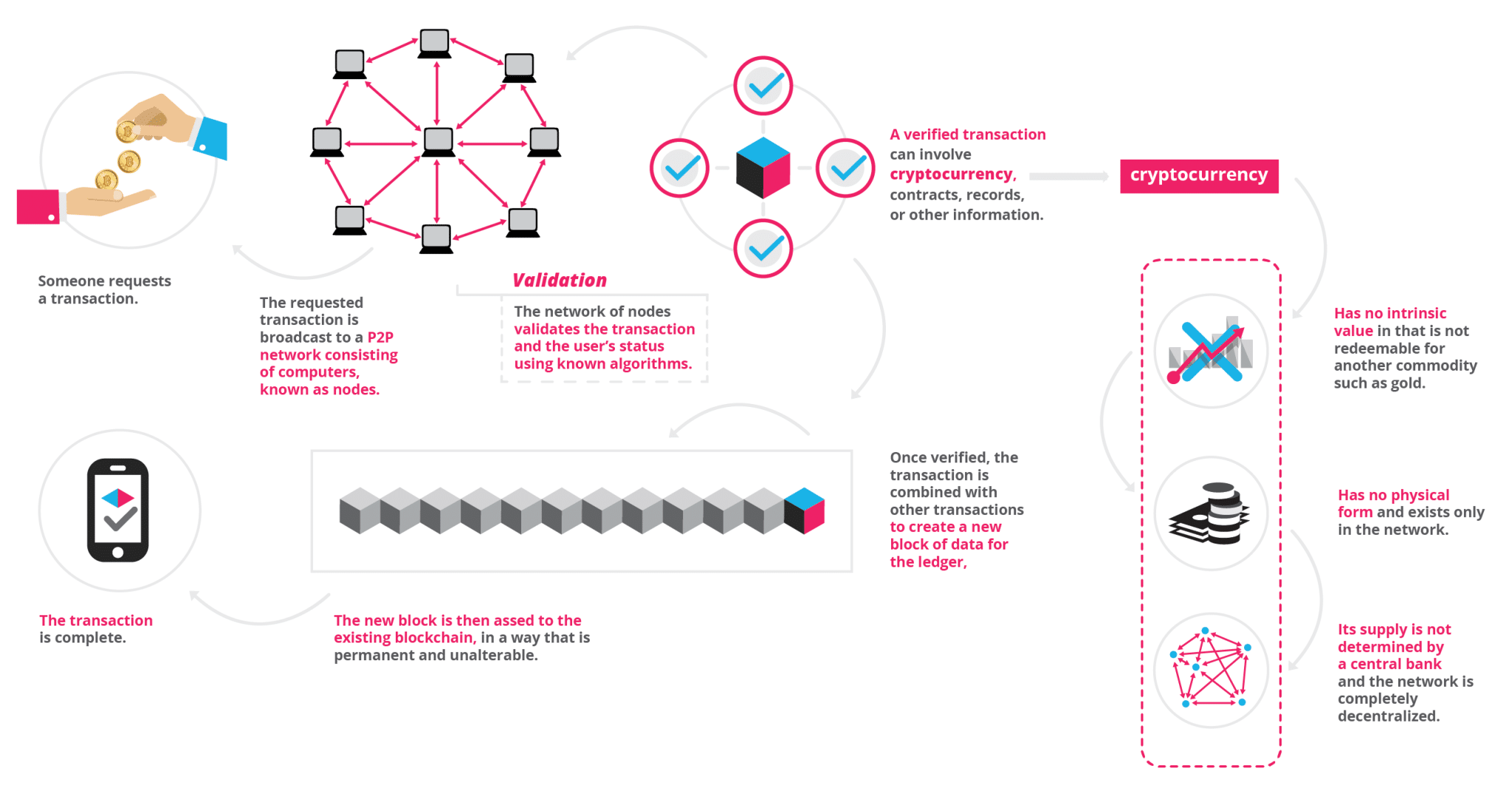
Before we can even fathom what Dapps do, we need to be familiar with its underlying technology—the blockchain. Put simply, a blockchain is a ledger of records organized in ‘blocks’ that are linked together by cryptographic validation. It is a digital storage of consensus truth. The key is to understand that this ledger is neither stored in a centralized location nor managed by any single entity, hence its distributed-ness. The block validation system results in new transactions being added irreversibly and old transactions preserved forever for all to see, hence its transparency and resilience. Open-source software that leverage on the blockchain technology are called Dapps.
The Birth of Decentralized Applications
As the concept is still in its infancy, there might not be one definition of what a Dapp is. However, there are noticeable common features of Dapps:
- Open Source. Ideally, it should be governed by autonomy and all changes must be decided by the consensus, or a majority, of its users. Its code base should be available for scrutiny.
- Decentralized. All records of the application’s operation must be stored on a public and decentralized blockchain to avoid pitfalls of centralization.
- Incentivized. Validators of the blockchain should be incentivized by rewarding them accordingly with cryptographic tokens.
- Protocol. The application community must agree on a cryptographic algorithm to show proof of value. For example, Bitcoin uses Proof of Work (PoW) and Ethereum is currently using PoW with plans for a hybrid PoW/Proof of Stake (PoS)5 in the future.
If we adhere to the above definition, the first Dapp was in fact Bitcoin itself. Bitcoin is an implemented blockchain solution that arose from problems revolving around centralization and censorship. One can say Bitcoin is a self-sustaining public ledger that allows efficient transactions without intermediaries and centralized authorities.
The Ethereum Network
While both Bitcoin and Ethereum may be loosely defined as Dapps aimed at solving real-world problems, Ethereum has a much bigger plan in mind.
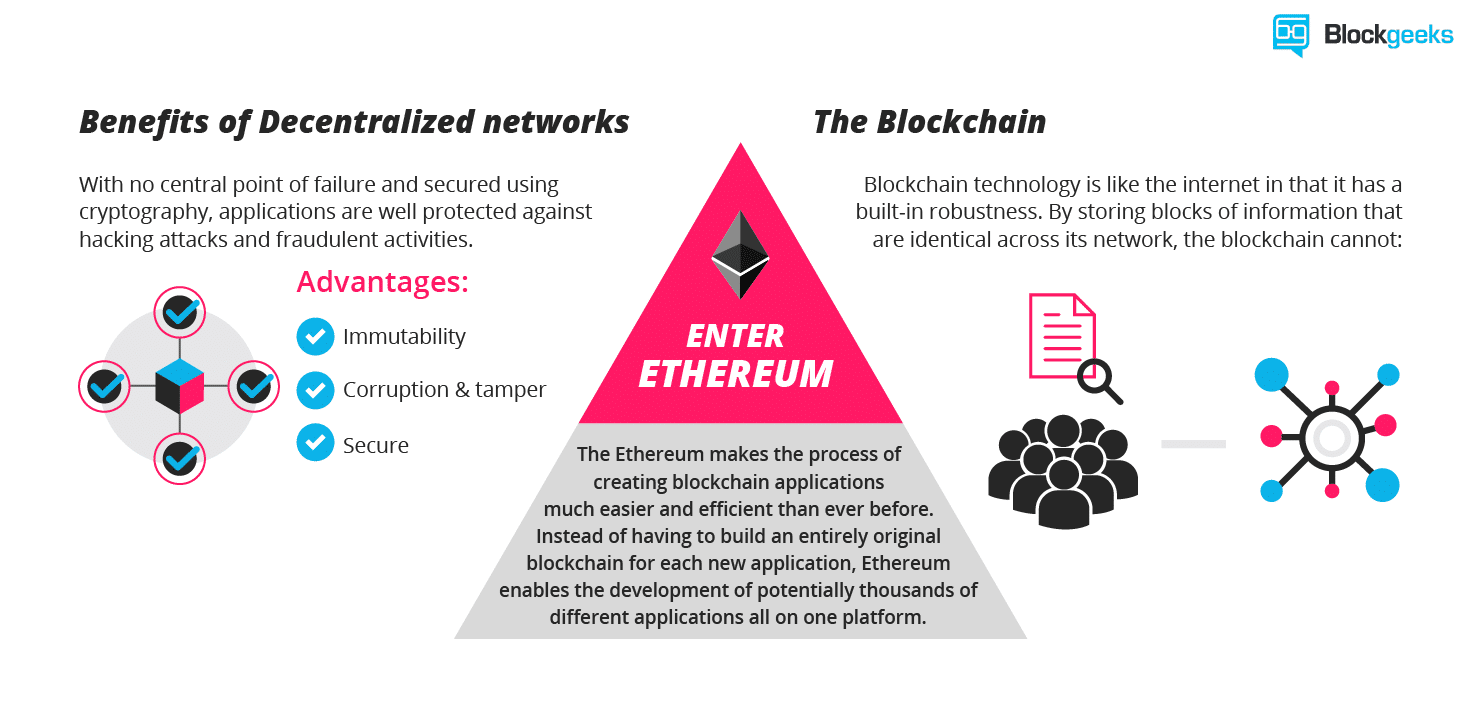
In Ethereum’s white paper, it was stated that the intention of Ethereum is to create an alternative protocol for building decentralized applications with emphasis on development time, security, and scaling. You may think of Ethereum as, for the lack of a better analogy, the Mother of Dapps. Armed with its very own language, Solidity, Ethereum enables developers to form smart contacts using the Turing-complete Ethereum Virtual Machine (EVM). With these tools available, developers made Dapps that have real-life use cases, ranging from asset management to resource planning.
Examples of successful Ethereum-based Dapps that have achieved millions of dollars in market cap include Golem, Augur and Melonport. As I mentioned in my previous post, each of them aspires to rewire the economy using blockchain technology, and move us a step closer to a decentralised world.
Successful Ethereum-based Dapps
Golem. The Golem project aims to create the first global market for idle computer power. Standing at a remarkable market cap of 220 million USD, Golem will release the first version, Brass Golem, in May. Brass Golem will be tested on its ability to tackle CGI rendering, its first use case. If it turns out to be sustainably successful, CGI artists will be able to rent computing resources from other users to render an image quicker. Likewise, an idle machine can also accept tasks from other users. In light of this, frictionless sharing and pooling of resources may be a reality sooner than we think.
Augur. Augur aims to combine the concept of prediction markets with the power of decentralised network to create a forecasting tool, for potential trading gains. Standing at a market cap above 200 million USD, Augur is currently still under beta test. Eventually, it may be able to feed real-world truths into other applications and establish itself as the blockchain of facts.
Melonport. The Melonport protocol is a blockchain protocol for digital asset management. Participants can set up or invest in digital asset management strategies in an open and competitive manner. Using blockchain technology, time and costs are drastically reduced. By building an auditable and visible track record, Melonport enables a never-seen-before competitive environment in asset management.
Status. Status transforms your mobile device into a light client node on the Ethereum Network and enables you to easily access Ethereum’s entire ecosystem from anywhere. Within their messenger system, users may send smart contracts and payment to each other. Server downtimes is now longer a problem as the app runs on peer-to-peer protocol.
Brave (Upcoming ICO). In a world where consumers struggle to be in control of their attention and privacy, Brave’s value proposition seems rather unique. A shocking 60% of web page load time is caused by the underlying ad technology. Brave browser makes web browsing fast and safe by shielding you from third-party tracking. On top of that, should you choose to support content creators by enabling ads, you may even be monetarily rewarded with tokens. This gives end users an unprecedented level of control.
Aragon Upcoming ICO). Aragon is another ambitious project. It aims to disintermediate human trade, and allows you to manage entire organizations using the blockchain. By removing geographical borders and paperwork, the Aragon Network aims to act as a digital jurisdiction that is extremely convenient for everyone to operate on.
As seen above, each Dapp intends to apply blockchain technology to its niche and take over their respective industries. Be it investment, technology or governance, blockchain technology will permeate markets; its omnipresence will grace the world.
Being a Part of the Dapp Revolution
The Ethereum ecosystem will continue to expand as Ethereum gets under the mainstream radar. The recent rise in the price of Ether have brought along a new wave of interest in blockchain application.
Article Written by: Suji Velu
Article Origins from: Blockgeeks


